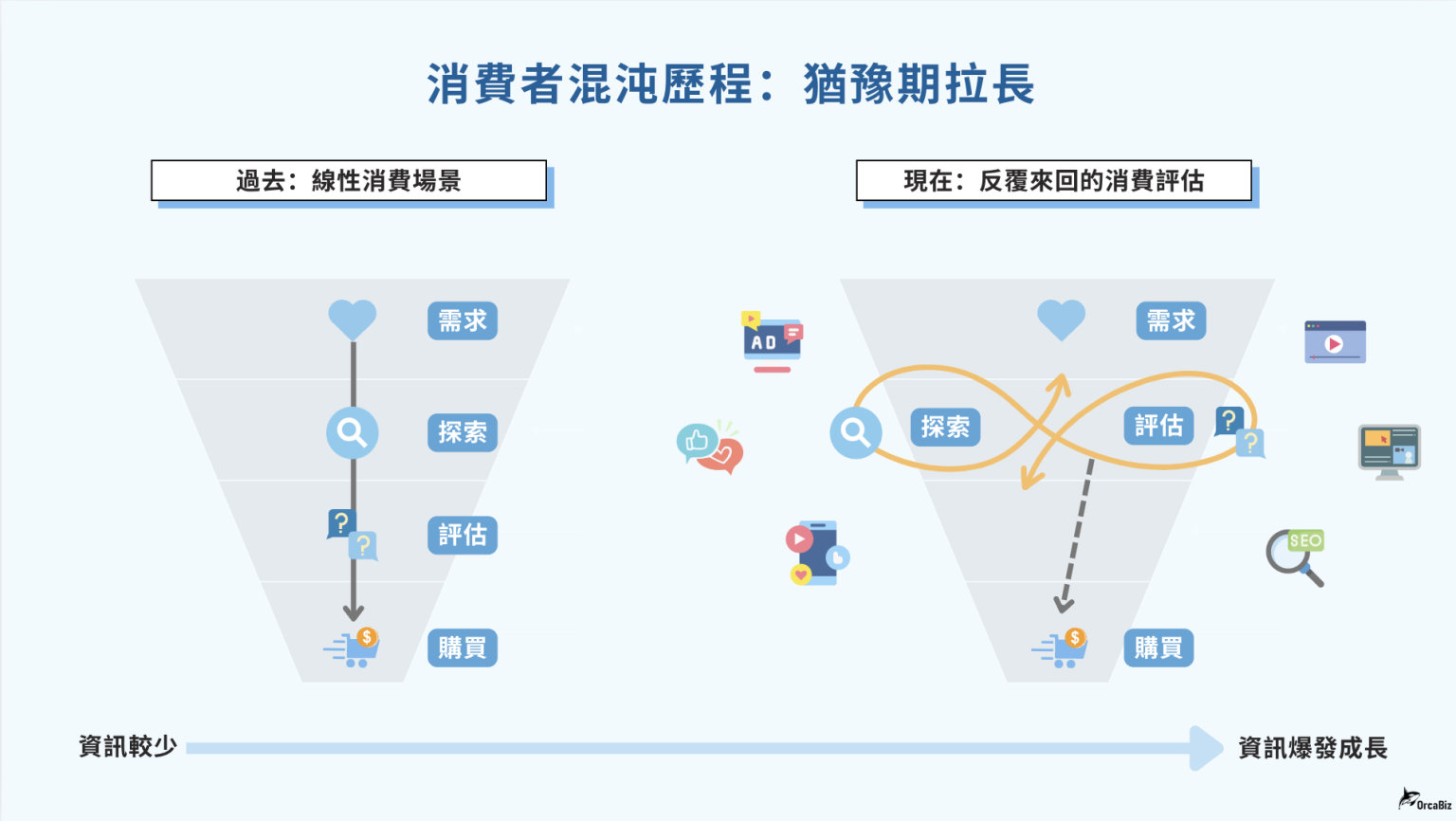
Google’s market insight experts, in the “2021 Smart Consumer Key Report,” identified a phenomenon where the traditional linear consumer journey is gradually being replaced by the “messy journey.” The report reveals that before making a purchase, consumers willrepeatedly jump betweenExplorationandEvaluation(Evaluation). Understanding and utilizing the Messy Middle is key to grasping the modern consumer mindset.
What is the “Messy Middle”?
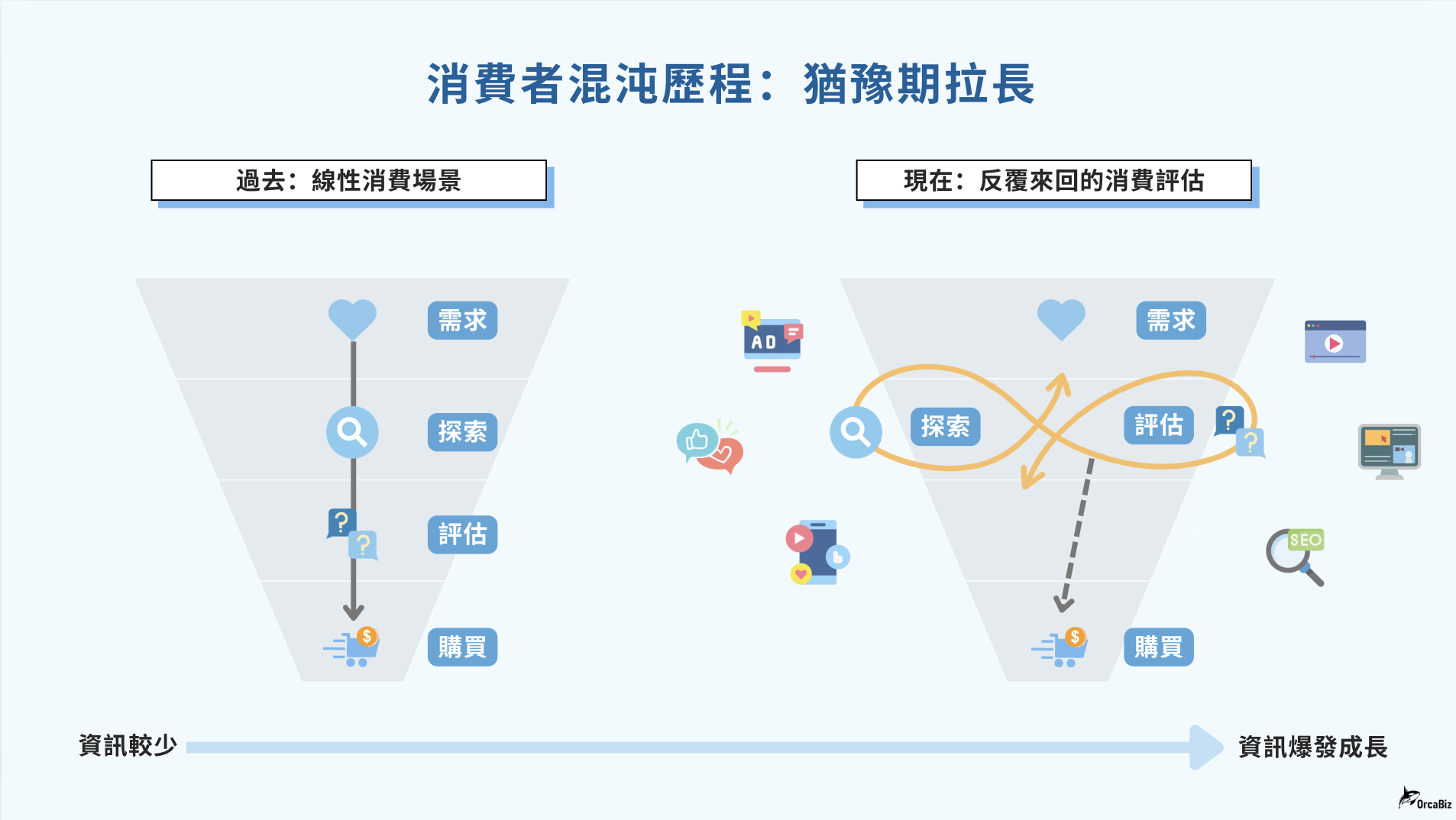
「Messy Middle” is a non-linear and iterative consumer behavior model. With the explosive growth of information channels, consumers’ purchasing journeys have become more complex and disordered. Consumers no longer follow the traditional sequence of purchase needs, exploration, evaluation, purchase, and loyalty, but instead constantly jump between exploration and evaluation until the evaluation is complete, at which point they decide to purchase.
- Exploration: Widely collect information related to brands and products.
- Evaluation: Compare and filter based on the information already obtained.
The main ways to explore and evaluate are nothing more than multi-channel searches, such asofficial websites, social media, blogs, shopping platforms, professional reviews and unboxings, and user reviews, etc.
Core Characteristics of the Messy Middle
- Multiple Touchpoints: The number of touchpoints where brand products interact with consumers has greatly increased, includingonline and offlineVarious media and platforms.
- Information overload: Consumers are exposed to a vast amount of information, requiring them to spend more time and effort researching products.
- Repeated exploration: For the same product, consumers mayhesitate between different brands. They repeatedly search for reviews and unboxing introductions through multiple channels, trying to find any missed evaluation factors.
What challenges do brands face in the messy middle?
In the messy middle consumer journey, brands face the following challenges:
- Peer competition: The number of brands consumers are exposed to has greatly increased. How can a brand stand out among numerous competitors?
- Fragmented attention: Consumerattention is fragmentedacross different platforms and communities, and traditional one-way advertising is no longer enough to capture consumers’ attention.
- Decision Delay: Due to information overload, consumers’ decision-making time is extended, leading to a decrease in purchase conversion rates.
Cracking Consumer Cognitive Biases in the Messy Middle

※Image fromHow people decide what to buy lies in the ‘messy middle’ of the purchase journey
Google’s research shows that consumers are deeply influenced by six cognitive biases during exploration and evaluation:
- Category Heuristics: Concise and clear product information can effectively simplify consumer decisions.
- Present bias: Consumers tend to choose products or services that can immediately satisfy their needs.
- Social Proof(Social Proof): Reviews and recommendations from other consumers are highly persuasive.
- Scarcity bias(Scarcity Bias): Limited supply or reduced inventory can make products more popular.
- Authority Bias(Authority Bias): Expert endorsements or authoritative recommendations influence consumer choices.
- Power of Free(Power of Free): Free gifts can significantly increase product appeal.
These cognitive biases exert varying degrees of influence on consumer decision-making, providing important entry points for brands to formulate marketing strategies.
Four Strategies to Guide Consumers Through the Chaos Journey Faster
Strategy One: Enhance Brand’s Omnichannel Visibility and Improve Overall Shopping Experience
Break away from traditional single-channel thinking and reallocate marketing resources from an omnichannel perspective. The multiple touchpoints in the chaos journey require brands to be discoverable by consumers at every stage.
- SEO Optimization: The most direct way iswebsite SEO optimization, ensuring the brand has a high ranking in search engines. In addition to brand keywords, product keywords and service item keywords must be continuously managed.
- Content Information: Provide consistent andclear product informationon various platforms, such as prices, features, and usage tutorials.
- Social Media Engagement: Be active on social platforms that consumers follow, building deep interactions.
- Online and Offline Connection: Whether online or offline, ensure consumers can obtain information at any touchpoint.a consistent shopping experienceto meet consumers’ diverse shopping needs.
Strategy 2: Leverage Behavioral Economics to Strengthen Brand Communication
Behavioral economics influences the irrational factors in consumer decision-making, also known as cognitive biases. Brands can optimize their strategies in the following ways:
- Mere-exposure effect: Enhance brand visibility to make consumers more familiar with the brand.
- Ambiguity aversion: Highlight product advantages and use value on product pages to reduce consumer uncertainty.
- Present bias: Offer limited-time promotions or instant feedback to satisfy consumers’ immediate needs.
- Scarcity bias: Utilize limited-quantity events to shorten consumer evaluation time and accelerate the purchase process.
- Bandwagon Effect: Display authentic user reviews and expert endorsements to provide social proof and authority bias.
- Projection Bias: Use scenario-based marketing to help consumers imagine how the product can meet their needs.
Strategy 3: Combine AI and Machine Learning to Shorten the Distance Between Exploration and Purchase
Machine learning technology can help brands identify target audiences and efficiently allocate resources during the messy middle:
- Personalized Recommendations: Utilize big data and AI to push tailored product information to consumers.
- Smooth Shopping Process: Reduce page jumps and overly complex payment processes.
- Automated Marketing: Use AI-powered tools to automatically adjust ad content and delivery strategies for precise marketing at the right time.
- Instant Problem Solving: Provide quick answers through AI customer service bots or FAQs.
Strategy 4: Build a Flexible and Efficient Cross-Departmental Team
The messy journey highly requires brands to have cross-functional operational capabilities. By integrating information from marketing, product, and customer service departments, consumers can receive a consistent brand image and service across different channels.
Dental Clinic Marketing Strategy: A Comprehensive Guide from Exploration to Appointment
In the digital age, traditional service industries like dental clinics also need to face consumers’ “messy journey.” When patients look for high-value dental services, such as orthodontics or dental implants, they usually go through multiple explorations and evaluations before deciding whether to make an appointment, considering factors like clinic reviews, professional expertise, service prices, or location.
1. The Patient’s Messy Journey
The patient’s journey in seeking dental services typically consists of the following stages:
- Trigger: Toothache, discomfort, routine check-ups, or cosmetic needs (e.g., teeth whitening).
- Exploration(Exploration): Search for information about dental clinics, including location, services, professional background, etc.
- Evaluation(Evaluation): Compare clinic reviews, service prices, actual cases, and refer to other patients’ shared experiences.
- Appointment(Purchase): Choose the most suitable clinic after evaluation and complete the appointment.
Patients repeatedly jump between the exploration and evaluation stages, referring to multiple platforms (Google, social media, professional forums) and various sources of information (price, technology, reviews).
2. How can clinics improve their visibility?
(1) Enhance digital exposure
- Website SEO optimization: Ensure the clinic’s official website ranks high in search results, for example, “Taipei Dental Clinic」、「Invisible Braces Recommendation” and other keywords.
- Google Business Optimization: Createa complete Google Business Profile page, including clinic opening hours, services, price range, location, and upload high-quality photos of the clinic.
- Social Media Management: Share on social mediathe story of the clinic and the doctors、patients’ smile stories, etc., and reply to fan comments to build trust. Simultaneously manage Instagram Stories, publishing information on limited-time offers to attract appointments.
(2) Provide clear and attractive information
- Service Description: Describe the clinic’s professional techniques and services in a concise and straightforward manner on platforms such as the clinic’s official website, Google Business Profile, and official social media.
- Transparent Pricing: Prevent patients from abandoning further evaluation due to non-transparent pricing.
- Instant Booking System: Provide an online booking form and indicate available time slots.
- Limited-time offers: For example, “Book today and enjoy 10% off your first dental cleaning” to satisfy patients’ psychological need for “immediate gratification.”
(3) Enhance Trust
- Patient Testimonials and Reviews: Invite patients to share genuine feedback, providingThird-Party Certifications。
- Case Studies: Obtain patient authorization to share successful treatment cases (e.g., before-and-after photos of orthodontic treatment).
Conclusion
In the “Messy Middle” of the consumer journey, brands not only need to understand consumer purchasing behavior but also need to adopt an omnichannel mindset for strategic responses. Only when brands truly align with consumer needs and pain points,providing the most suitable solutions at critical touchpoints, can they stand out from the competition.
Frequently Asked Questions
What is the Messy Middle?
The Messy Middle is a non-linear consumption pattern where consumers repeatedly jump between exploration and evaluation until they make a purchase decision. This differs from the traditional linear consumer journey, and is instead composed of multiple touchpoints, information overload, and repeated comparisons.
What challenges does the Messy Middle pose for brands?
The main challenges include: ① intense competition among peers, with a significant increase in the number of brands consumers encounter; ② fragmented attention, making traditional advertising difficult to attract; and ③ delayed decision-making, as consumers prolong the purchase process due to information overload, leading to lower conversion rates.
Which cognitive biases influence consumers in the Messy Middle?
Google research indicates that six major cognitive biases influence consumers: ① Category Heuristics, ② Power of Now, ③ Social Proof, ④ Scarcity Bias, ⑤ Authority Bias, and ⑥ Power of Free.
How should brands respond to the Messy Middle?
This can be achieved through four main strategies: ① enhancing omnichannel visibility (SEO, content consistency, social interaction); ② applying behavioral economics (repeated exposure, limited-time offers, social proof); ③ integrating AI and machine learning (personalized recommendations, automated marketing, AI customer service); and ④ establishing cross-departmental collaboration teams to ensure a consistent brand experience.
How can dental clinics respond to patients’ Messy Middle journey?
Patients of dental clinics typically go through exploration and evaluation stages, including comparing reviews, prices, and case studies. Clinics can improve conversion rates by: ① enhancing digital exposure (SEO, Google My Business, social media management); ② providing clear information (service descriptions, transparent pricing, online booking); and ③ increasing trustworthiness (authentic reviews, case sharing).